Content
TL;DR
What is Somnia
I. Foundational & Strategic Analysis
1) Vision & Investor Alignment
2) Team & Execution Prowess
3) Capital & Endorsements
4) Market Opportunity & Fit
5) Competitive Position & Differentiators
II. Pre-Launch Ecosystem & Go-to-Market
1) Community & Narrative Momentum
2) On-Chain Footprint
3) Partnerships & Readiness
4) Tokenomics & Value Accrual (Today)
III. Forward-Looking Analysis (Catalysts & Opportunities)
IV. Valuation Scenario Analysis (TGE FDV)
Competitor Landscape (token angle at/near TGE)
Final Take

Markets Confusing? Ask Edgen Search.

Instant answers, zero BS, and trading decisions your future self will thank you for.

Try Search Now

Somnia L1: Dream Computer for On-Chain Worlds

· Mar 31 2026
Somnia L1: Dream Computer for On-Chain Worlds

An outlook on Somnia’s specialized L1 for metaverse and gaming, covering strategy, partners, token model, catalysts, and valuation. For a simple guide for new users, click here

TL;DR

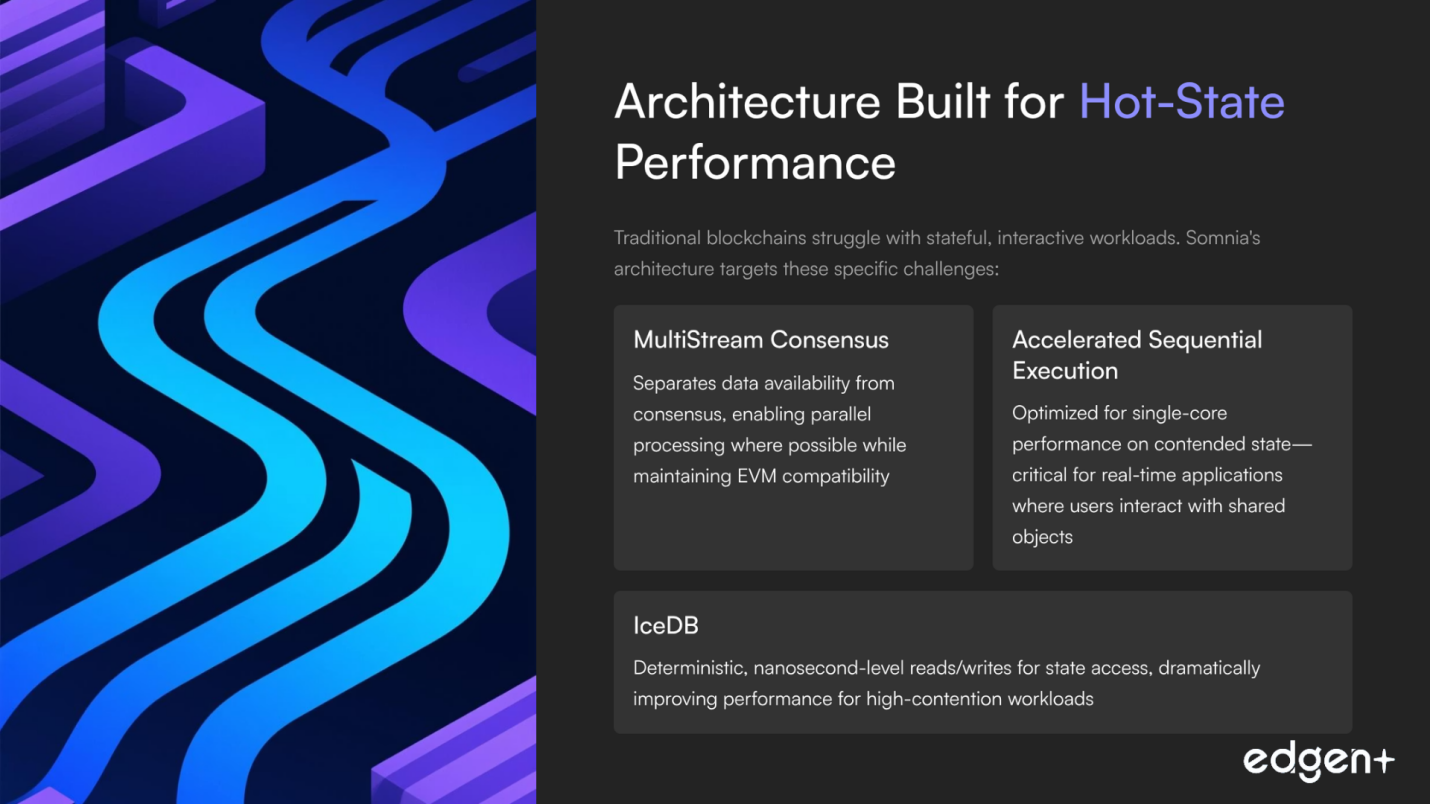
  • Specialized L1 for real-time apps: Architecture (MultiStream Consensus, Accelerated Sequential Execution, IceDB) targets hot-state workloads other chains struggle with.
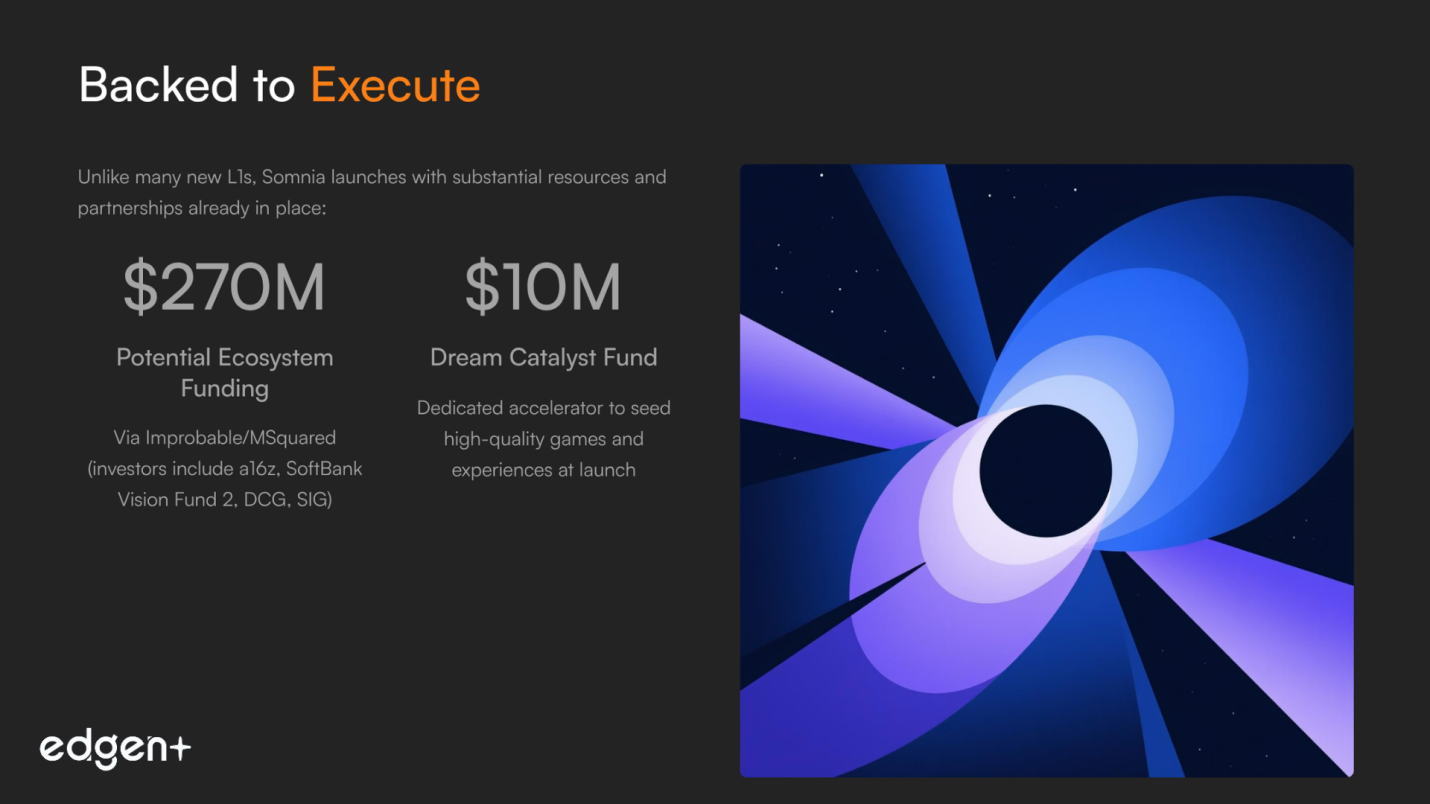
  • Backed to execute: Up to $270M in ecosystem funding via Improbable/MSquared, Google Cloud validator/infrastructure, and a $10M Dream Catalyst to seed games, positioning Somnia to convert narrative into shipped products.

What is Somnia

Somnia is an EVM-compatible Layer-1 engineered for metaverse-scale performance: sub-second finality, sub-cent fees, and 1M+ TPS targets. Rather than chasing general DeFi throughput, Somnia is optimized for stateful, interactive workloads—MMOs, social graphs, on-chain economies—using a design that accelerates single-core execution for hot contention while leveraging hardware parallelism. Its MultiStream Consensus separates data availability from consensus, and IceDB aims for deterministic, nanosecond-level reads/writes.

Backed by Improbable/MSquared’s deep experience in virtual worlds, Somnia aligns infrastructure with developer reality: familiar EVM tooling, a low-code builder stack (via partners), and a well-funded accelerator to bring content on day one. With Google Cloud supporting validation and AI/data security services, and studios like Realm (Variance) preparing to build, Somnia’s proposition is clear: a “dream computer” where Web3 experiences feel instant and composable—ready for mainstream users.
I. Foundational & Strategic Analysis

1) Vision & Investor Alignment

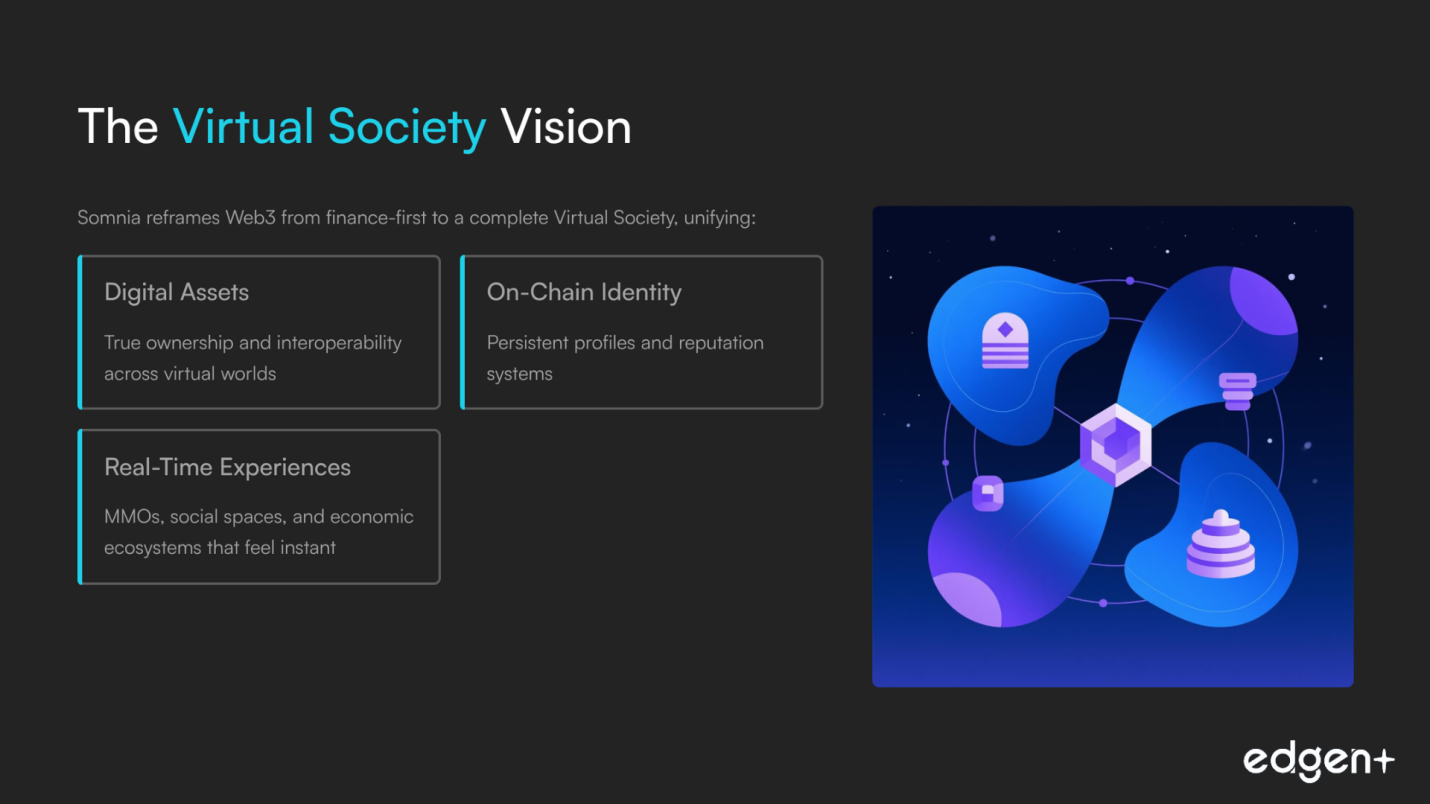
Somnia’s thesis is focused: become the specialized L1 for metaverse/social/gaming, where performance, latency, and cost decide winners. The strategy reframes Web3 from finance-first to Virtual Society, unifying assets, identity, and experiences. Partnerships (e.g., Yuga Labs alignment) and a $10M accelerator signal long-term commitment to content and developer success.
2) Team & Execution Prowess

Founder Paul Thomas (Improbable) brings rare distributed-systems depth; Michelle Kang adds L1/L2 growth expertise. The blend of infra rigor and GTM know-how supports complex protocol delivery and ecosystem onboarding, very promising for a new L1.

3) Capital & Endorsements

Rather than conventional rounds, Somnia benefits from ecosystem funding up to $270M via Improbable/MSquared (investors include a16z, SoftBank Vision Fund 2, DCG, SIG). Google Cloud validates at an enterprise level (validator + AI/data/security), while Sequence and Rarible accelerate developer and market readiness.

4) Market Opportunity & Fit

On-chain gaming/metaverse is large and expanding. Somnia serves builders who need reliable, high-contention performance with EVM familiarity, plus grants, SDKs, and distribution, reducing both technical and financial switching costs.

5) Competitive Position & Differentiators

Competes with gaming-centric EVM chains (Ronin, Immutable zkEVM, GalaChain) and high-throughput L1s (Solana, Aptos). Differentiation: hot-state execution focus, full EVM, ambitious “Virtual Society” narrative, and authentic virtual-world pedigree from Improbable.
Foundational take: Remarkable foundational strength with aligned capital, credible partners, and a purpose-built design for real-time, on-chain worlds.

II. Pre-Launch Ecosystem & Go-to-Market

1) Community & Narrative Momentum

Top-of-funnel growth is massive, driven by testnet and incentives. The opportunity now is to convert breadth into depth, institutionalize comms, highlight shipped dApps, and channel community energy into mainnet usage.

2) On-Chain Footprint

Testnet activity has been stress-scale, a useful systems proving ground. The key KPI post-TGE is quality usage (DAU, retained wallets, live dApps), not raw transactions.

3) Partnerships & Readiness

  • Google Cloud: validator + AI/data/security integration for builders.
  • Sequence: smart wallets, Unity/Unreal SDKs, marketplace stack for the Somnia Builder.
  • Uprising Labs: $10M Dream Catalyst to seed high-quality games.
    Together, these reduce friction from code to users and help ensure day-one content.

4) Tokenomics & Value Accrual (Today)

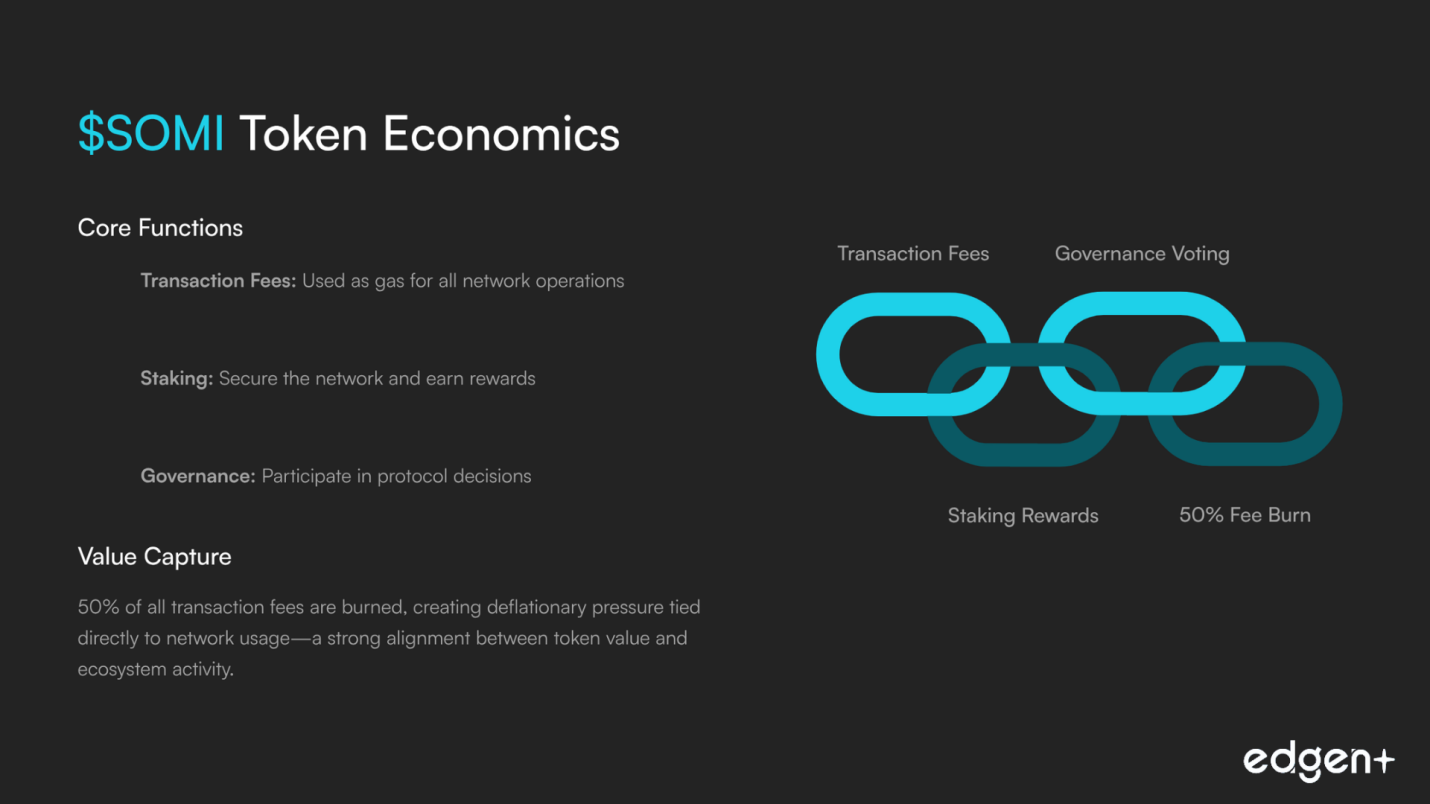
$SOMI: gas, staking, governance. 50% fee burn aligns value with usage. Airdrop (5% supply) vests via weekly mainnet quests (20% liquid at TGE; ~80% activity-gated over ~60 days) to encourage real participation from the start.
GTM take: Very promising. The stack, programs, and partners point to strong developer velocity; launch ops (custody/MM/liquidity comms) should be clarified to maximize day-one confidence.

III. Forward-Looking Analysis (Catalysts & Opportunities)

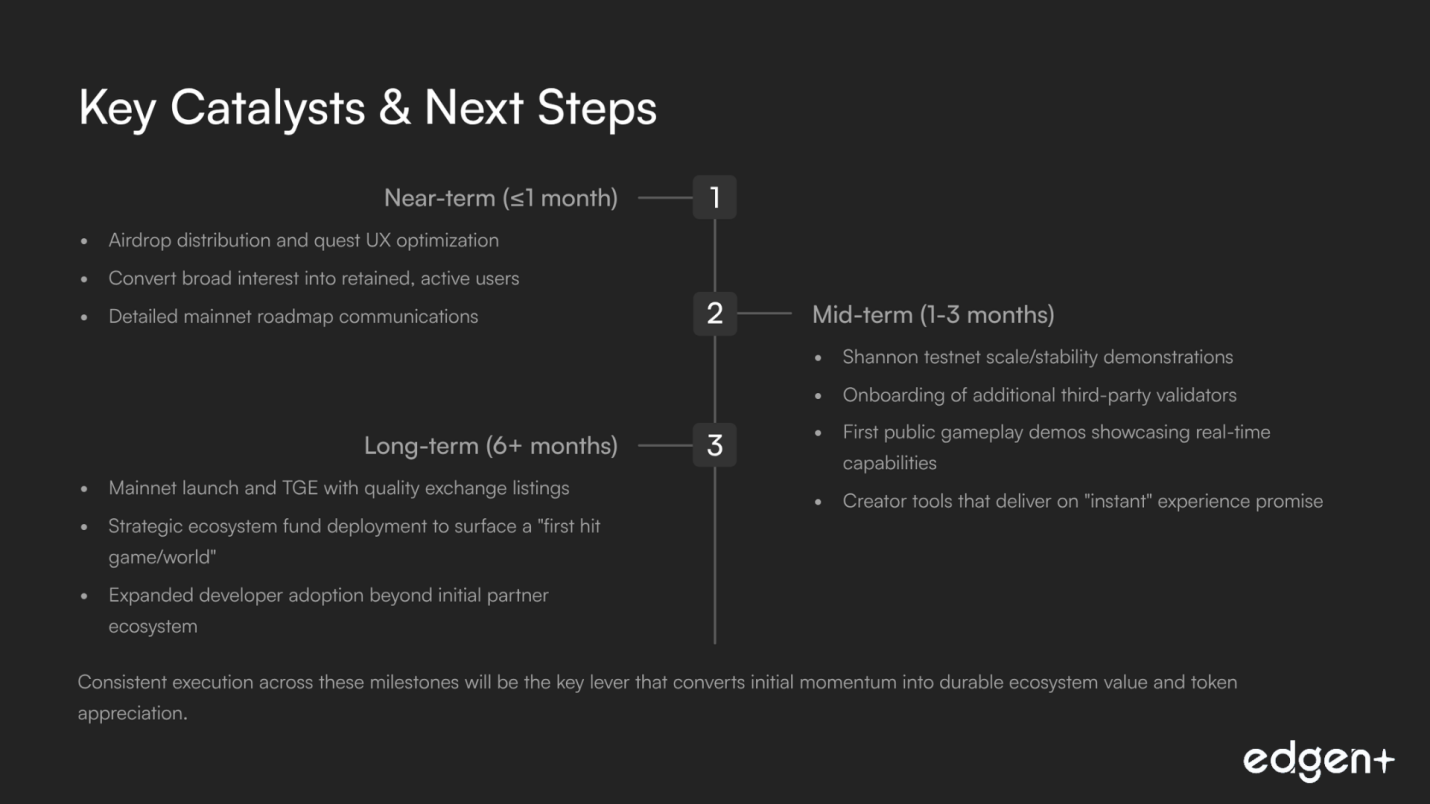
Near-term (≤1 month):

  • Communicate airdrop learnings + crystal-clear quest UX. Turning broad interest into happy, retained users can reset sentiment fast.

Mid-term (1–3 months):

  • Shannon testnet scale/stability proof and more third-party validators; first public gameplay and creator tools that feel instant.

Long-term (6+ months):

  • Mainnet + TGE with quality listings and liquidity; ecosystem fund deployment that surfaces a “first hit game/world.”

Execution cadence is the lever that converts momentum into durable value.

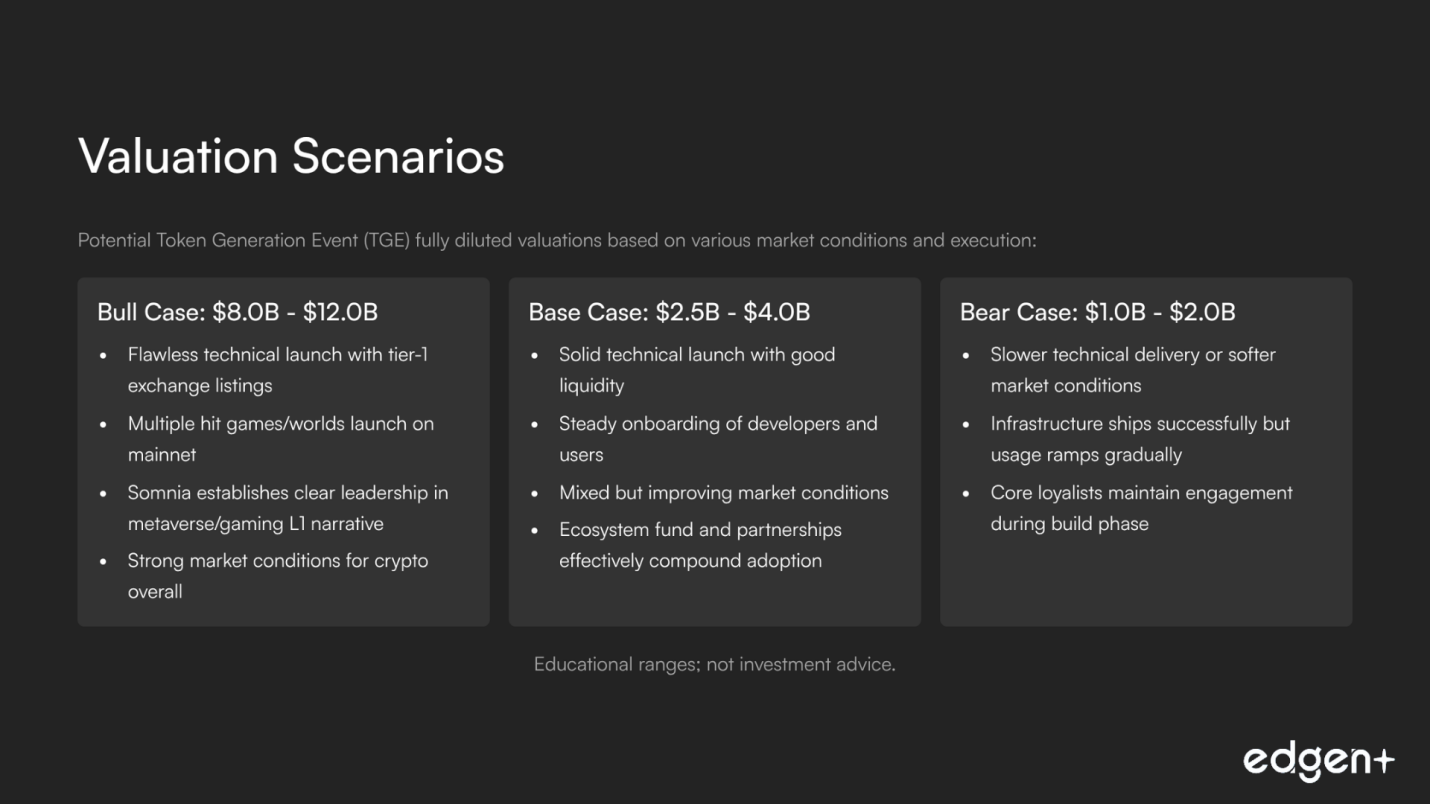
IV. Valuation Scenario Analysis (TGE FDV)

Scenario

FDV (USD billions)

Brief narrative

Bull Case

8.0 – 12.0

Flawless launch + tier-1 listing; hit games go live; Somnia leads metaverse/gaming L1 story.

Base Case

2.5 – 4.0

Solid tech + steady onboarding in a mixed market; fund + partners compound adoption.

Bear Case

1.0 – 2.0

Slower delivery or softer market; infra ships, usage ramps gradually with core loyalists.

Educational ranges; not investment advice.

Competitor Landscape (token angle at/near TGE)

Network

Token

Focus

Base-Case Position vs Somnia

Ronin

$RON

EVM L1 for gaming (publisher-led)

Strong proven pipeline; Somnia competes on broader open-world scope and raw throughput targets.

Immutable zkEVM

$IMX

L2 for games, marketplace strength

Deep studios + infra; Somnia counters with L1 performance + EVM + fee burn.

Solana

$SOL

High-throughput L1 (parallel exec)

Mature ecosystem; Somnia differentiates on hot-state performance story and EVM familiarity.

Aptos

$APT

High-throughput L1 (Move)

Strong tech; Somnia lowers dev friction via EVM + specialized metaverse narrative.

Final Take

Somnia looks very promising: a specialized, EVM-compatible L1 with a realistic plan to power real-time, on-chain worlds. With significant ecosystem funding, blue-chip partners, and a design aimed squarely at hot-state workloads, it’s set up to translate vision into usage. The path to upper-band valuation is straightforward but strict: crystal-clear launch ops, visible early games, smooth TGE, and consistent shipping.

Educational content; not financial advice.

Recommend
SpaceX prices its IPO June 11 at a $1.75–2T valuation. Most retail is asking "how do I buy SpaceX?" — here's the wider way to think about it, with three paths to be on the right side of the catalyst.

Investing in SpaceX Doesn't Mean Buying SpaceX

By Edgen Research | 2026-05-28 Everyone is talking about SpaceX right now. The S-1 went public on May 20. Pricing is set for June 11, trading begins June 12 under ticker SPCX, and the deal targets $80 billion raised at a $1.75–2 trillion valuation — the largest IPO in history by a wide margin. So the natural question coming up in every group chat, every brokerage app, every Reddit thread is: how do I buy SpaceX before it IPOs? Fair question. There's also a wider one underneath it that's worth a minute of your time. What most people are really after isn't a specific stock — it's being on the right side of what SpaceX is dragging up: reusable launch becoming the default, Starlink turning satellite connectivity into everyday infrastructure, space turning into the next platform layer for defense, telecom and industrial software. You can absolutely play that by buying SpaceX equity. You can also play it through stocks you can already buy today, sometimes with cleaner risk and without the IP
Edgen
·
May 27 2026
Five small fixes shipped this week to Ed by Edgen — refreshed web design with bell notifications, charts inside chat answers, simpler thinking process, voice input, and a homepage that knows you.

Ed Got Smarter This Week (May 22 Update) — Here's How

By Edgen | 2026-05-26 Your money person should solve the small annoyances first. This week Ed knocked out five of them — desktop and mobile felt like two different products, data answers were lifeless, you couldn't tell what he was thinking, typing detailed questions on the go was a pain, and the homepage didn't really know you. All five just got better. Web just picked up the same brand color, clean cards, and bell-notification setup the mobile app already had. Whether you open Ed on your phone in the morning or your laptop at lunch, it's one consistent product — and alerts find you on both. Ask Ed about a stock price, a market-cap split, or a year-over-year trend — the answer now comes back with a clean chart inside the reply. Same data, much easier to read at a glance, no need to imagine the picture from a wall of numbers. Ed is a proactive AI — what he's doing for you matters as much as the final answer. The thinking process is now one clean line you can follow: "Reading Goldman Sa
Edgen
·
May 26 2026
Aschenbrenner's Q1 13F: $5.52B in AI infrastructure longs (BE, SNDK, CRWV) + $1.6B NVDA puts. The puts are most likely a hedge — not a short.

Leopold Aschenbrenner's Real AI Bets: Bloom Energy, SanDisk, CoreWeave — the NVDA Put Is Probably a Hedge

What are the world's most-watched investors actually buying right now? The Q1 2026 13F filings — released May 15 — give the clearest answer in years: every major filer is building AI exposure. The disagreement is over how. The most-headlined case is Leopold Aschenbrenner — the ex-OpenAI researcher who wrote the Situational Awareness essay and now runs Situational Awareness LP ($9.28B regulatory AUM per the March 2026 SEC Form ADV; $5.52B of that is the disclosed U.S. equity book). The press ran with "Aschenbrenner bet $8.46 billion against AI chips." That headline is technically true and practically misleading. What he actually did with real capital: load up on the AI infrastructure that makes the boom possible — power, memory, data-center capacity. The $8.46B against NVDA and other chipmakers is almost certainly a hedge on those AI longs, not a directional bet against AI itself. If you're trying to build AI exposure for the long run, his buy list — and what 4 other big names are doing
Edgen
·
May 21 2026
Nomura raised SK Hynix's price target from ₩840K to ₩4M in 6 months — 5x. Goldman lifted MU's 2026 EPS estimate 133%. Why MU and SNDK move from Hold to Buy.

Nomura Quintupled SK Hynix's Target in 6 Months — A Tailwind for MU and SNDK

On May 17, Nomura raised SK Hynix's price target to ₩4 million won — roughly five times the level it set just six months ago. The size of that revision matters less than what Nomura wrote underneath it: AI memory demand is entering a "new regime" that breaks the historical cycle model. We're updating our #66 AI hardware basket map on the back of it — MU and SNDK move from Hold to Buy. The trajectory is the story, not the endpoint. Four sequential raises. Each one looked aggressive when published. Each one was conservative within weeks. The current PT implies +119.9% upside from the May 15 close of ₩1.82M — Nomura's bull case explicitly recalibrating to a "new regime," not extrapolating from the prior cycle. I'd argue the May 17 raise matters more than the four that came before it. The earlier raises tracked rising EPS estimates inside the same cyclical model. This one reframes the model itself — what Nomura calls "memory stock re-rating driven by exponential demand growth from AI." Nom
Edgen
·
May 18 2026
NVDA isn't the whole AI hardware trade. SanDisk +3,362%, Micron +340% past year prove it. Which AI hardware sectors still have upside — and which don't?

NVDA Is One Basket of AI Hardware. Here Are the Other Four, Ranked.

SanDisk is up 3,362% over the past 12 months (Yahoo Finance). Micron is up around 340% in the same window (Yahoo Finance). Both are AI hardware. Neither is NVIDIA. If you call yourself "long AI" but own only NVDA, you're not long AI — you're long one basket, and the other four ran without you. SNDK and MU are the proof of how expensive that miss can be. Here's the map. Five baskets. Where I'd put new money today (Basket 4) and where I wouldn't (Basket 1). Bottom line first. If you can only add to one basket today, I'd add to Basket 4 — Optical Interconnect. Not NVDA. Not HBM. Not foundry. One sentence: AI's bottleneck is shifting from "memory can't feed the GPU fast enough" (the 2024 problem) to "the wires can't connect 100,000 GPUs at once" (the 2026-2028 problem). The market hasn't fully priced this yet. AI-themed funds barely own any of the optical names.
Edgen
·
May 15 2026
earnings-beats-fail-2026-edgen-3-signal-framework_header.png

Why Earnings Beats Fail in 2026: Edgen's 3-Signal Framework

Something broke in Q1 2026 earnings that contradicts what most retail investors learned in 2023-2024. Affirm reported adjusted EPS of $0.37 against a $0.27 consensus — nearly 40% above the Street — and the stock fell 5%. Coinbase missed revenue by 31% — a catastrophic shortfall by any historical standard — and the stock declined only 2.5%. SoFi beat the quarter and raised full-year guidance, then dropped 15%. Palantir reported 85% year-over-year revenue growth — and went sideways. These are the four prints Edgen Research covered in real time during April and May 2026. Across them, the relationship between an earnings beat and stock direction has visibly decoupled. This is not a noisy small sample — it is a structural change in how the market processes quarterly information. Three signals appeared in every single beat-and-fade case we tracked, and they also predict — in reverse — the rare cases that beat and rally, such as NXP's +18% reaction to its Q1 print. This article is the framewo
Edgen
·
May 14 2026
affirm-investor-forum-may-12-2026-4-numbers-decide-stock_header.png
Coinbase missed Q1 by $70M and posted a $394M GAAP loss — yet the stock dropped just 2.5%. Why the bear case isn't paying out, and the OCC trade still works.
affirm-q3-2026-beat-raised-guide-may-12-forum-thesis_header.png
ZEC just hit $590 in 3 days — nearly our $600 PT from Monday. Now what? Monero (XMR) at $409 hasn't moved. Here's the privacy coin rotation play.

Your money person, finally.

Try Ed free. No credit card. No commitment.